Friday, December 16, 2011

Kindred souls in Costa Rica

"BRUUURP....  BRUUURP....             BROH-UHRP!"  
A tall, dark-haired 40-something Tico farmer creeps into foliage, listening.

"BRUUURP....  BRUUURP....             BROH-UHRP," he calls again for a creature of the night, waiting.  He whispers to me while gazing into the foliage, "He's close...."

Suddenly, a brave little "broh-uhrp" chirps back from behind some banana leaves.  Our farmer, who doubles as a wildlife guide, moves swiftly.  My travel buddy and I peer into the thick green.  Where did he go?  We've only just met this man, with whom we'd organized a nighttime nature walk after arriving tired to our hostel in La Fortuna, Costa Rica.  In the less than ten minutes we've known him, we've lost him in some overgrown bushes aside a soccer field.  We were feeling worried, apprehensive, and skeptical of this guy, our arms crossed and our eyes peering into the leaves, when he appeared behind us.

A startled Red-Eyed Tree Frog (Agalychnis callidryas)
"Here, get a picture," our guide said, as a Red-Eyed Tree Frog, Agalychnis callidryas, crawled off a held stick and onto a banana leaf.  We were stunned.  And then my camera shutter started clicking.  The stare from this beautiful Central American endemic, a popular and immediately recognizable symbol for rainforest conservation, dredged up childhood memories of rainforest dreaming.  Bright, orange feet, blue flanks and legs, and red eyes dazzled us, which is what they're meant to do.  See, the frog covers all these colors up when sitting on a leaf; it sits on its orange feet, it pulls its legs against its body, and it closes green eyelids.  When resting, it appears to be a green blob.  Should a predator investigate the green blob, the non-poisonous frog resorts to its "startle coloration" for defense - the frog opens its eyes, flashing the enemy with color before making an escape.  This potentially freaks out their predators.  Of course, that means great photos for us crazy nature tourists!  Sure, flash me, frog - better for the camera!  They can live to 5 years, and will vocalize to attract mates or warn off other males (competition is intense - males get a free ride on the female's back during mating).  It was one of these brave males that fell for our guide's deception, countering with its own defiant "broh-uhrp."  It was the defiant "broh-uhrp" rebuttal that solidified Geovani Bogarín's legitimacy as a fantastic wildlife guide that night.

A terebellid flatworm navigates the fungal forest under a log
You can learn about Sr.  Bogarín's 20 year history as a wildlife guide in La Fortuna from the New York Times article written about him in 2008.  I'd rather share what the article glossed over - his respect for all species.  You see, a person doesn't "memorize" 850 species of birds, as the Times author wrote - or 50 species of frogs, or hundreds of species of trees, orchids, and mosses - in the same way that you don't "memorize" the names of your family and friends.  You know their names because they play a role in your life; you see them and interact with them, laugh and cry with them, perhaps share a meal with them.  I understand this, too; from all my time underwater in the Red Sea I have "memorized" hundreds of fish, crab, snail, slug, and worm species that were part of my life then.  Geovani knows these birds, lizards, frogs, ants, and bats because he lives in the forest and pays attention to it.  His "house" is just a wooden deck supported ten feet off the forest floor by large posts.  Corrugated steel acts as a roof to keep out the rainforest's eponymous weather.  A propane camping stove rests on a table in one corner - the kitchen.  A hammock is stretched between two supporting posts on the other end - the bedroom.  He leaves bananas out for the raccoons that like to visit sometimes.  And at night, he rocks in his hammock and listens.

Blue-jeans frogs Oophaga pumilio secrete unpalatable toxins
For the past 10 years, Geovani has been developing a trail through that parcel of jungle right off the main street in La Fortuna.  Here he challenges his ecotourists, "make a list; what species do you want to see?"  He's calling it the "Parque Natural Los Niños," and 20 years of wildlife guiding means he knows what we want to see, and that he can find it among these trees.  "So many people come here and they don't see what they're looking for - I heard about some German girls a few days ago who paid $65 for a wildlife hike and they didn't even get to see a sloth," Geovani said, shaking his head.  (The sloth, "oso perezoso," literally translated to "lazy bear," is one of the most well-known residents of Costa Rican forest life - just look high up in the Cecropia trees and you'll see one sooner or later!)  Of course, Geovani's observation can be interpreted a few ways - the larger, federally-sponsored national parks where most wildlife tours are conducted have high standards, more land to maintain, and more stakeholders to please, services which all must be paid for.  And you can't guarantee wildlife sightings, right?

A large brown spider (Sparassidae?) camping out on bananas
But with his comment, I see Geovani shares my lament - while many have become acquainted with nature, few understand it.  With understanding comes guarantees for cool creature spotting.  Nature is a system; except for modern humans, all life obeys rhythms.  The annual shift in the angle of the sun's rays on Earth lead to weather (wind, evaporation, rain) and seasonality, which control the abundance of various plants.  These factors act with others, like the phases of the moon, to trigger significant events in the lives of animals and support their growth.  When frogs give birth, for example.  Or when dragonflies take flight.  Or how many larval instars of huntsman spiders will survive until adulthood.  Or if the mot-mots or oropendulos will decide there is enough food or absent predators to justify leaving for the annual migration to a low-valley avocado tree instead of a high fern in the cloud forest.  When we lived in nature, as a human species, we noticed such cycles and made decisions using them as well - they told us about our surroundings, about the weather, about our food.  Sure, today Geovani's understanding of the call of a lusty frog or the location of a mother sloth with child brings him direct monetary income - and indeed perhaps the only way to understand so deeply is to make it your full-time job - but in the past these things would have been the pulse of our friend, the forest, the land we live on.

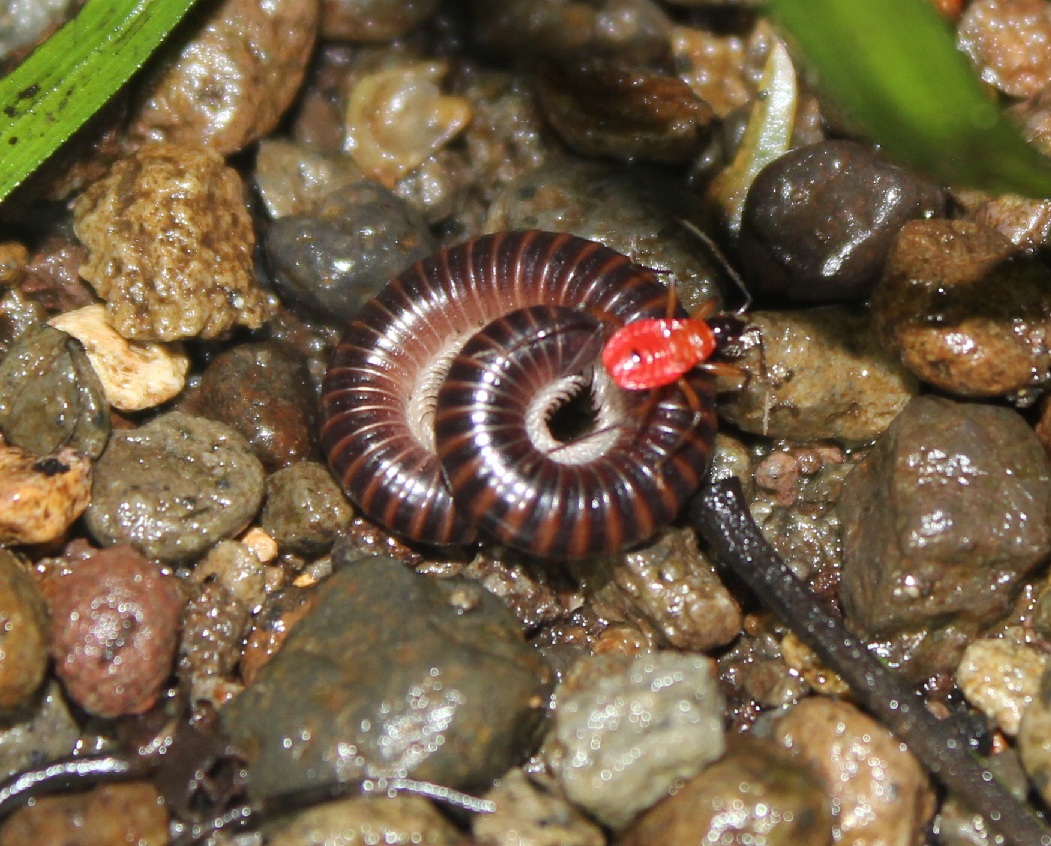
Polydesmid millipedes may excrete cyanide to deter predators!
As Geovani and I discussed these truths, as we lamented modern society's ignorance or apathy towards the one "philosophy" that has the power to support humanity because it provides food and shelter just by existing, my travel buddy watched the fireflies blink on and off in haphazard loops, merely awaiting the moment when the hippie talk would end and the newfound camaraderie would be celebrated with beer.  After all, our modern society runs on lawyers and iPhones and barbie dolls and Burger King, and we are products of our upbringing - beer was surely forthcoming (for those of age)!  But it is these rare glimmers of mutual understanding I occasionally find in random others that remind and confirm to me that I am a member of the human species, a creature with a role and a long history in this system.

An insect undeterred by millipede defenses!
If you go to La Fortuna and want to hang with Geovani Bogarín, try calling him at 86269348, or just ask any of the locals.  They all know him, and really seem to like him, too.

Wednesday, November 30, 2011

Remembering Malta

The beautful, highly-developed Maltese coastline
The country of Malta, where I lived during the summer of 2011, was a crowded place.  On an area a bit smaller than the Massachusetts islands of Martha's Vineyard and Nantucket combined lived 417,000 citizens, speaking their own language and with their own fierce culture.  I lived in the hugely overdeveloped tourist district, the town of San Giljan (St. Julian's).  Road ran directly along the perimeter of this whole northeastern coast, with hotels and "lidos" (beach clubs) every block, all more or less attached to each other the whole way.  And lapping at the limestone just below the road or sometimes the tiny adjacent bedrock seashore was the blue, blue Mediterannean.

Can you spot the goby amid the diverse algal forest?
No rivers flow into the sea here, nor is the tiny island close enough to any continent for there to be significant coastal pollution.  You can see into the water for perhaps 30 meters when you are not in a major population area, like where I was living, but even then you could see 10 meters deep!  To celebrate the fact that our apartment was a mere hundred feet from the sea, which, as a marine biologist, I love, I jumped in every day.  I would go for a run to get my exercise and really overheat myself so that I could stay in the sea longer.  I carried my snorkeling gear in a bag on my back, and ran in my bathing suit!  After the run, I'd walk down to my beach of choice (anywhere I hadn't yet explored along the coastal stretch), take off my shoes, put on my mask and snorkel, and jump in holding my house key!  The water was warm in summer, 27 C / 80 F, so with the added heat of the run I could stay under comfortably for hours.

Calmella cavolini, a Mediterranean aeolid nudibranch
The benthic (i.e. bottom) habitat of the Mediterranean has no coral, but rather a forest of hundreds of different species of marine algae.  These wild red, green, and brown multi-textured growths are kept neat and trim by dozens of species of herbivorous creatures, particularly sea breams, that snack on the algae every day.  The resulting short, trimmed, underwater bonsai forests are thus the perfect habitats for me to hunt for the minute sea creatures that often bring so much wonder - nudibranchs, tectibranchs, pycnogonids, caprellids, harpacticoids, isopods, turbellarians!  I'd search through them with glee, and occasionally find a creature I'd never spotted before.  I'd run home to look it up, or bring it with me for a photo - giggling like a schoolgirl all the way, sometimes skipping dinner.  (Although I would always return the creature where I found it.)

Some of my favorite creatures were the octopods.  Yes, that is the plural of octopus.  The octopus is more common in the Mediterranean than any other sea I'd been in.  I can guarantee you an octopus while snorkeling right off the tourist beach.  In tiny holes, cracks, and crevices, they occur every hundred feet or so underwater, watching the world.  I used to love to interact with them.  They all had unique personalities!  I usually carry a single wooden chopstick with me to move around algae without having to use my fingers.  The first time I came across an octopus while snorkeling after a run, it reached out of its cave and wrapped its tentacles around my chopstick!  Surprisingly strong, the octopus wrestled the chopstick from my hands and I had to fight to get it back!  Curious whether or not this was a common behavior, I approached an octopus I saw on another day with my chopstick, only to have it flee from its cave squirting ink at me as it jettisoned away!  Yet another octopus lazily aimed its siphon at my hand and tried to blow the chopstick away from its lair with the jets of water pulsed out of its mantle.

Of course in every place where people live near the sea, there are people that love the sea.  Some of my time in Malta was spent volunteering with a non-profit shark conservation organization, SharkLab Malta, a subsidiary of a UK group.  With them I helped to lead snorkeling tours and collect data about sharks at the local fish market (at 3 am, an early business worldwide).  As a trained PADI Rescue Diver with lots of research diving experience, I also joined in on coastal dive surveys to, well, look for unrecorded species around the island.  We would go wherever we figured we'd find unique habitats, taking a tiny boat and SCUBA gear to sand patches, dropoffs, Posidonia seagrass meadows, and submerged limestone caves.  Among our many discoveries - which is what we call a trained mind attaching more importance to something than other observers - was the Bull Ray (Pteromyleus bovinus), swimming in 20 feet of water over a sandy bottom off a popular beach.  Though a Mediterranean species, it wasn't known from Maltese waters.  Malta is an isolated island, so finding species there known from elsewhere in the Mediterranean still means a lot; it means they had to get there somehow, at some point in their ancestral history.

I met many good people in Malta, made many good friends, had a lot of adventures, made a lot of memories.  The dives I have done there were magnificent.  If you want to see Mediterranean marine life, stop by  Malta.  It's a magical little country!

Sunday, November 13, 2011

The Fisher (Martes pennanti)

Seeing my hometown of Grafton, Massachusetts, USA as more than just my youthful stomping ground has been difficult.  I grew up in this area; every street and landmark has some connotation to me that no visitor would see.  It is funny that while traveling I desperately seek that "local" feeling to truly understand a place, while at home I wish to discard the "local" feeling and look at my surroundings with unbiased eyes!  But I'm finding that these "local" connotations skew my knowledge of what Grafton, even Massachusetts, has to offer.  Today I stepped outside my "local" knowledge by exploring one of the Grafton Land Trust's properties, the Hassanamesit Woods.  Despite the fact that the entrance to this excellent conservation land is only two miles from my front door, I had never visited in my life!  Here was a new location to view Massachusetts wilderness objectively.  Despite the fact that it's November, and most of the leaves (and even branches!) of the trees have fallen due to an early snowstorm, it was still a beautiful afternoon walk.  Meandering around from 2-4 PM, the last thing I expected to see was a giant, black-furred mammalian predator on the prowl!  But that's what appeared in front of me - perhaps a hundred feet away down a long stretch of trail among the white pine forest, what I at first thought was a black dog turned and peered back at me - probably because I shouted "WHOA, WHAT IS THAT?!"

The missing link!  ...Or just a startled fisher.
I know, I know - my picture looks as legitimate as the photographs of the Loch Ness Monster.  But a friend put me on the right path with her guess - a fisher!  These amazing creatures, which live for a maximum of 7-10 years in the wild, are one of the largest representatives of the Mustelid family (the taxonomic order containing skunks, weasels, otters, ferrets, etc.).  They can get to three feet long and weigh up to 12 pounds.  They are endemic to North America, and more common in the northern part of their range (Canada).  They actually were pushed to local extinction in the late 1800's to early 1900's due to excessive hunting (for their fur) and intensive logging activity that destroyed the dense pine forest habitat they need to survive.  Thanks to a reduction in logging and a moratorium on hunting in the 1930's, the fisher population began to recover and expand their range.  Now fishers are known throughout Massachusetts, and even a bit further south into Connecticut.  Hunting activities resumed in the 1950's, though heavily regulated.  In fact, this is the middle of the Massachusetts fisher season - trappers can catch them (with licenses) from November 1st to November 22nd!  (Don't worry, they're not endangered.)

Young fisher kits!
Fishers are more famously known for their terrifying but fascinating screams, which sound like a person being attacked!  If you're near a large, heavily-wooded pine forest, you might hear one calling for a mate on a cool April evening.  Although fisher copulation (which can last for 7 hours, how about that) results in fertilized embryos in April, the female fisher doesn't actually implant the embryos in her uterus until the following February - 10 months later!  (This fact confounded fur farmers that thought they could grow this species just like other furbearing mammals - the impatient farmers couldn't figure out why the females didn't seem to get pregnant!)  After a gestation period of 50 days, the female finds a nice hole in a tree to give birth and raise her 1-4 "kits."  After about 5 months, she kicks them out and the young fishers must begin their solitary lives.

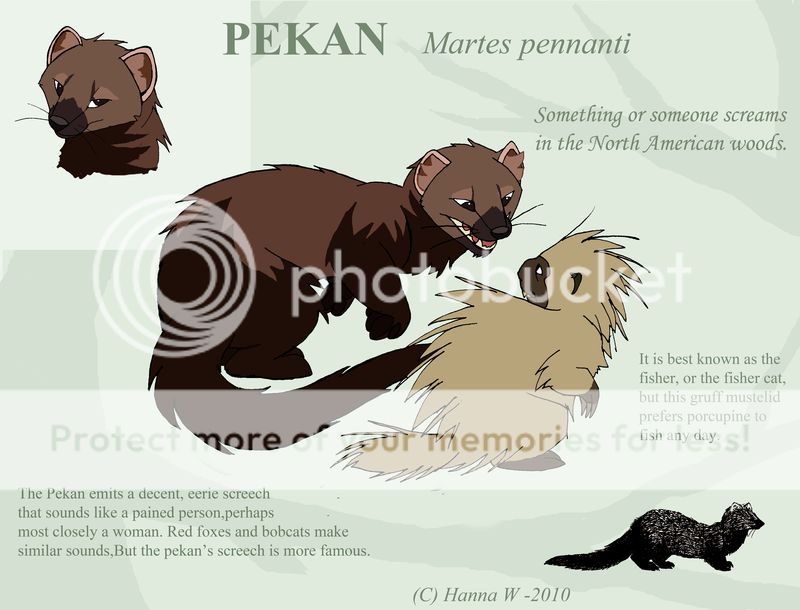
"Pekan" is an indigenous name; don't try to make pie with one.
Another awesome fisher fact - they are the prime enemy of porcupines!  Apparently other predatory mammals in the region are too "tall" to attack a porcupine - getting only a mouthful of quills!  But fishers are low enough to the ground to coordinate an attack to the face of the porcupine.  And what an attack!  It may take half an hour for a fisher to kill a porcupine this way - circling the porcupine and repeatedly biting at the face!  Afterwards, they dodge the quill problem by flipping the dead porcupine over and dining on the soft underbelly.  These warm-blooded carnivores are active all year round - no hibernation - and need to eat the equivalent of 1-2 squirrels per day to keep their energy up!  (They also eat snowshoe hares, mice, shrews, and carrion of larger animals).

Outside the mating season, fishers are solitary creatures that establish habitats of about eight square miles, with little overlap for individuals of the same sex.  This means that in the whole Hassanamesit Woods area of Grafton, you might only see a single male and a single female!  See if your local New England pine forest has fishers around.  They spend most of their time on the ground (NOT in trees) and are most active during the "crepuscular" hours - sunrise and sunset.  To learn more cool facts about fishers, check out the "Mammalian Species" journal article that I got most of my information from and an info pamphlet on fishers from the Massachusetts government.  Of course, Google and YouTube have great stuff too!

What a great day in the woods.  Maybe I'll go again soon, wait with coffee and an MP3 player, and try to get better photos.  The experience just goes to show how close new experiences are to your own home!