Wednesday, February 27, 2013

From captive reefs to Saudi seas, for sea slugs, & beyond!

Don't leave meeeeeeee!
Last night, I chased a train.  My sneakers, a thick boxy pair of skate shoes, greatly protested the inappropriately quick pace they were not designed to handle.  So too argued my jeans, winter coat, laptop bag, half-eaten bag of pita chips, and frazzled mind.  A tooting whistle signaled imminent departure; as I rounded the last bend, leaning into my own momentous curve, I saw the taillights at the platform.  "ah-HeY!" I squawked awkwardly, a scrambling stork, dropping pita chip fragments - "YOO-hoo, HELLO? Wait!!"  Disembarking passengers walked past, some with grins, urging me on; others with embarrassed grimaces; the worst with blank detachment from the comedy of life.  As I stared at the burning red beacons of budget travel, I noticed the lights were not getting closer.  I looked at my feet; they were still moving, crunching salt and ice crystals as they went.  It was merely at the same rate the train was departing.  A devil-on-the-shoulder thought grabbed my mind- "Sprint," it said; "grab the rear car; sprint, and make your athletic endeavour an unsung secret victory!"  Whether it was maturity, prudence, sanity, or the anti-adventure shoulder angel, I stopped running, and watched the blazing red beacons burn away into the night.  A pause.  The mind reboots.  With a shrug, I dropped all my belongings and heavy outer layers.  I looked up to the heavens and let loose a barbaric yawp of primal frustration.  And I called Tommy's Taxi for a more financially burdensome ride home.  The night was an omen from an unseen shade; the spirit of travel.  I was being welcomed back to the realm of adventurous uncertainty.
~~~

The night was my last working for Tropic Isle Aquarium, my savior job since moving home, and it was a little frantic - like every work day.  So it did not surprise me that, given my choices to fight the American norm by going car-less, I found myself farcically running an improperly-attired 1.9 mile gauntlet to the Framingham station to catch the P535 in 14 minutes.  A little over two weeks ago, I informed the owner that I had gotten the rare opportunity to return to the Kingdom of Saudi Arabia for a research cruise.  Dr. Michael Berumen, director of the Red Sea Research Center's Coral Reef Ecology Lab, where I had studied for my Master's, has known of my sea slug passions since the show I put on there last year, celebrating little sea creature diversity.  As a mentor, he would like me to consider continuing my studies in this field; and I have certainly thought of it.  Indeed, I have found no stronger peace of mind and soul than exploring the reefs of the world, and I have been actively applying to career jobs that give me the chance to return.


The Lybia crab carries anemones for defense!

You may have noticed I have not written much on this blog since I began the 40-hour week at the aquarium.  While I am incredibly grateful to the job that allowed me daily interaction with ornate and ecologically fine-tuned Pom-Pom Crabs (Lybia spp.), flighty Palette Surgeonfish (Paracanthurus hepatus), and the always inquisitive Rockmover Wrasse (Novaculichthys taeniourus), it was mere life-support to the nature lover's soul.  A business is not academia; as I often told people, we ran a zoo that we sold animals out of.  I worked there because I wanted to learn more about the aquarium trade, for a story I have longed to tell so strongly that its become a personal mythological Siren, driving my life onto sharp rocks.


The Oxynoe sp. 4 I collected off Jeddah
Though I hesitate to return to academia, where I have found solace in the sea but not solace in science, I cannot resist the chance to give it another look.  Among the impressive names on the cruise are Dr. Terry Gosliner, Dean of Science and Research Collections at the California Academy of Science, as well as Dr. Gustav Paulay, a curator at the Florida Museum of National History, who I visited in Florida last year (and apparently failed to write about).  These two giants of the invertebrate zoology world will be side by side, snatching up secret sea creatures left and right, and hopefully helping me write up technical reports on my own opistho discoveries - like the potential range expansion for the slug I found in Saudi Arabia last year.  In addition, I'll have time for some whale sharking and photography diving.  As I am running out of time to write this story, let me just say that I will endeavor to document the story of the science we are performing over there; insh'Allah it will be invigorating more than just aesthetically.  Let those who'd call my attitude juvenile, optimistic, flowery, flagrant, or perky be damned!  This is nature through Noah, and it will be documented!
~~~

When I retun, I will be left with choices once more on where to go next.  Ah, the sweet anxiety; what is it I need?  Richie, my taxi driver last night, called it "permission to leave," and was of the opinion that it is very hard to give it to yourself. He's a fellow American who has lived in Chile, driven from Boston to Tierra Del Fuego, and written for literary magazines, and he wanted to share with me three things after hearing about my imminent journey(s)...  The first, to protect your spirit; the second, to not be afraid; and the third, to know that there is no ceiling in life.  The $65 ride, paid after missing the $3.50 train, may have been fate's way of relaxing me before tomorrow's flight back to the land of Ibn Saud, to the still mysterious Red Sea, to search for the slugs of yesteryear and tomorrow, and other dream-creatures yet to be known......  I hear them calling as I sit in my parent's home, bags of scuba gear, photographic equipment, and a few articles of clothing piled up by the door, waiting for the airport limo to sweep me off my feet.

Tuesday, September 18, 2012

Tibet, New Hampshire


Three hours from my central Massachusetts home, the Appalachian mountain range rises.  They're smaller than the Rockies, those beautiful white-capped crags of the central USA, but this is because the Appalachians are older; almost half a billion years old to the Rockies' 50 million.  After being weathered down over all that time, the Appalachians are more like a series of high hills now.  One particular hill in New Hampshire, Mount Washington, has a surprising reputation for a small mountain - it is ferocious!  Though it is a "mere" 6,288 feet tall (Mt. Everest, the tallest on Earth, reaches 29,029 feet), the collision of various weather phenomena bring hurricane-force winds to Mount Washington on a regular basis; about a third of the year.  In fact, the strongest winds ever observed by man* were recorded here - at 231 miles per hour.  So I was no doubt excited to hike it when a friend mentioned it a few weeks ago.
Despite living nearby, I'd never visited; only vaguely heard about it from t-shirts, bumper stickers, and water cooler conversations.  My hiking buddy told me that when she climbed last October, her group wore layers of winter clothing and were often too cold to take more than one photograph before looking for cover from the bone-chilling winds.  Needless to say, being a fit, brave 25 year-old field biologist, I was excited to tackle the beast when we arrived in the morning.  Fogs that hung over the morning landscape stoked the mystique of the coming adventure.  We started up the Tuckerman Ravine Trail to the summit - a mere 4.4 miles that takes 4 hours to hike as it gains 4,000 feet in elevation over that distance.

Leafy green deciduous forest is the first to welcome us on the well-kept rocky paths.  Dominating over evergreens at lower elevations and latitudes, these trees cast green and yellow hues on the trail, and pepper it with yellowed leaves during fall.  Right away, you feel you are in deep wilderness.  Though small towns are less than ten miles away, it is amazing what a distant world one can experience here.  Located within the White Mountains National Forest, it is not the same as a National Park - extractive activities like logging are allowed throughout much of it.  Yet about one fifth of this area is reserved for recreational and scientific purposes only - no logging.

As the altitude rises, deep-hued evergreens like pines and firs outcompete the broad-leafed deciduous trees.  As the evergreens provide cover all year round, and precipitation is abundant, thick blankets of soft, spongy moss grow to cover the forest floor.  It creeps even to the edges of the trail, and beckons to weary hikers looking for a comfortable place to nap.  Many stretches of the trail weave so narrowly through this area that it becomes a sedate grotto - shielding the light, absorbing all sound but the occasional red squirrel's rolling chitter, and maintaining a brisk humidity.  As we pass the trees in silence, we breathe in a deep aroma of the Christmas holiday - the powerful fir tree's terpene-laden resin - which triggers distant childhood memories...

Eventually, not even the evergreens can survive the high-altitude climate, and we enter the alpine zone.  Here, there are no more trees to paint trail-marking "blazes" on, and instead piles of rocks called "cairns" are erected to note the location of the trail.  Fragile alpine flowers like bluets, azalea, and rosebay bloom in this harsh area during the summer months, but as we've made the ascent in the fall, the majority of turf-like foliage between the rocks has turned hay yellow.
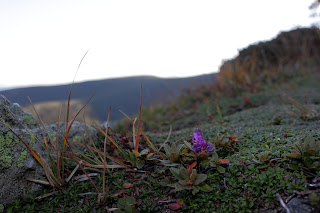
Lapland Rosebay (Rhododendron lapponicum), exposed hillside

It becomes hard to follow a trail as we approach the summit itself; it appears to be nothing more than a pile of giant granite boulders covered in chartreuse lichens, littered with occasional cairns.  Though only tenths of a mile are left, the constant hopping and climbing seem to yield no progress.  But we totter on, and arrive at the top with exhausted ankles, calves, soles, and backs.

...Of course there are other ways to reach the summit, including a road and the zealously-touted "cog railway," which uses gears instead of wheels to climb the steep mountainside.  Immediately our meditative solitude is invaded by bikers, families with prams, and cheeky French Canadians.  After hours of muscle work, hydration, and contemplation, it is unsettling to say the least; we take our "I was there" summit picture, and move on.

Motorcycle tourists at the top

Hydrating in a summit building


Tomentose Burying Beetle (Nicrophorus tomentosus)
As you might expect, it wouldn't be Nature Through Noah without an animal encounter.  On a windowsill in the summit building, I noticed this Sexton Beetle, or Burying Beetle (Nicrophorus tomentosus). About an inch long, with beautiful fall colors (my favorite season), it's as if this bug is pre-costumed for Halloween.  And it's story is certainly haunting.  Also known as "burying beetles," they locate small dead animals - like birds and mice - then proceed to bury them by digging beneath them.  Beetles may remove fur or feathers at this time to line the new tomb.  Once safely ensconced in the new crypt, the beetles excrete chemicals over their gruesome prize that slow its breakdown by fungi and bacteria.  Beetles then use pheromones to tell mates that the macabre love nest is ready.  When a partner arrives, eggs are laid within the chamber, where young ones will hatch and feast...  Oh, and the genus?  It means "death carrier."  Muahahahaha.

Our return journey is even more surreal.  We decide to take the Crawford Path down to the Davis Path to the Boott Spur trail.  And the latter paths extend for a long way atop the alpine zone; a welcome spread of flat land to hike over that nonetheless feels like an alien landscape.  Flaxen hay, white quartz-topped cairns,  green lichens... And of course, our purple mountain majesties...  When the trail dropped below the treeline once more, we had lost much sunlight.  Navigating by shadows down endless cascades of yard-high boulders requires poise, and more breaks.  We take our last snack at twilight on a mossy carpet, vision fading, reflecting on the day, before the last tenths of a mile take us to our car.


This blog tries to show you nature through my eyes.  Yet to date, my gonzo journey across the natural world has been largely animal biased - and marine, at that.  With all my background education in the marine sciences, this is no surprise.  It was only when a fellow marine biologist brought spider babies into the lab once to look at under a microscope that I realized all life was peculiar.  Yet this past Thursday showed me I've also been ignoring all those beautiful abiotic (i.e. nonliving) factors "nature" also implies; like landscapes.  When you think of nature, what do you see, readers?  For many, the idea of "nature" is "untouched wilderness" - a portrait that includes a beautiful landscape.  (This untouched wilderness idea is a point of contention I'll expand on some other day; it's folly.  We're animals too, we're just playing house.)  To date, I've shunned such expansive outdoor adventures in the United States; I've always felt that I can see America when I'm too old/xenophobic/responsibility-laden to explore new countries anymore.  Thus I've rarely explored my own country, despite knowing that there is great beauty to be found here.  I'm saving it, like a fine wine; and exploring abroad now.  But a side effect is that I lose the connection with my home country, not realizing it can be this beautiful; as beautiful as the Tibetan plateau.  Although this is a story for another time, I joined others for a three-day hike in the foothills of the Himalayas outside Kathmandu, Nepal back in April of 2011.  And although we were staring off into the distance at some of the world's highest peaks (the Langtang range reaches 20-23,000 feet high), I couldn't help but recall that view when standing on the edge of Mount Washington's Tuckerman Ravine, surveying the skyline.

Exploring the Langtang Range in Nepal with a Saudi friend in 2011.

Wednesday, August 15, 2012

A surprisingly large spider...

I remember what it's like to be afraid of swimming alone in the sea at night in deep water far from shore; or of walking on bare feet through the dense understory of wild rainforest.  I remember because, while it may seem like I'm fearless now, there are occasional reminders!  Bravery is the end result of two properties: courage, and knowledge.  The courage is a gut curiosity that keeps you going, despite what your head tells you.  The knowledge is the truth behind the courage that supports that curious strength.  They play off each other.  I had the courage to explore the woods, then gained the knowledge about the risks of Lyme disease from tick bites and what kind of wasps sting, etc., which bolstered my courage to go deeper, darker, thicker.  To lay down among the rushes to photograph a strange spider, mite, toad, flower, or weevil.

Thus, though I was once afraid of being in a forest at night (I'm a marine biologist), I've learned more and trodden deeper, because I live here now.  One of the tidbits of knowledge I'd picked up to make romping through the New England woods easier is that, being far from the tropics, I assured myself, there were no large and lethal monster arthropods that I could run into.  Sure we've all heard of the Black Widow spider, but they are so rare!  Even whispered common name terrors like the "Brown Recluse" spider or "Water Mocassin" snake don't occur up in New England.  It is thus with great curiosity I reacted to a recent voicemail from my stepmother about a "huge yellow spider" in the backyard.  Sure, sure.  I lazily reached for my camera, thinking it would be just some curious 2-cm Salticid, or some such nonsense.  I pushed face first through the arborvitae hedges and lilac bushes bordering my parents' houses and went to check out this mystery...

...and sweet Nancy Sinatra, she was not kidding!!!  I realized the creature before me disagreed with everything I was previously sure of.  Resting in a web a foot off the ground, a bright black and yellow spider with a body the size of my thumb stretched legs long enough to make the palm of my hand seem small.  In Massachusetts, USA!  A region of North America where life freezes over in wintertime.  Staring at this huge yellow beast, I began to hear a steel drum playing in my head, like I was on a Caribbean island for an entomological expedition, warm breeze going by, rum drink in hand, diligently studying guidebooks with a fellow scientist to memorize the target species of the trip while getting sloshed.  (This is often how science works.)

What we'd found was Argiope aurantia, or Yellow Garden Spider (around here).  It occurs throughout North America, from southern Canada southwards.  Somehow, I don't recall seeing any of the 3 inch long (with legs outstretched) adult females from my boyhood days around the yard.  Which is particularly surprising, as this female's web was right next to our swimming pool!  One cool feature of their web is the thicker bunch of zig-zagging silk in the middle, called the stabilimentum, whose debated function might be to camouflage the spider, attract prey, stabilize the web, or act as the band-aid on the glass door (i.e., to warn large animals that there is a web in the way, please do not crash through it).

My favorite thing to learn about this creature was that, when disturbed, it will rock back and forth in its web like a baby in a jolly jumper, up and down, merely by flexing its legs.  Perhaps to make itself seem larger?  Or perhaps to make it a more difficult meal to pinpoint?  Perhaps even a way to tangle up potential prey!  Their eyesight is so poor that it's likely a bet hedging scenario - a useful behavior for a range of situations.  But confusing to watch at first!  I like to think she's saying "hello."


Like many arthropods, this female will not survive the winter.  This far north, a life cycle is completed every year.  Maybe this summer isn't your best; but for many creatures, it's the only one of their life.  Enjoy it!